
 Within CJCE’s Amplifying Global Research virtual issue, you will find the 5 top-viewed articles published between 2025 and 2026 from each of the following continents: Africa, Asia, Europe, North America, and South America. Over the next several months, we will be highlighting the articles from each of these sections in a series of CIC News stories as a means of spotlighting the excellent research being conducted across the globe in chemical engineering.
This month, we will be highlighting the articles in this virtual issue with corresponding authors from institutions within North America. As many of the co-authors of these articles are from various regions, countries, and continents, this reflects the truly international collaboration that is taking place in chemical engineering research.
The first article in this section is an open access article titled “Review of recent advances in the design, synthesis, and modification of biochar for remediation of heavy metal pollution in water” by Soumik Chakma, Mehedi Hasan, Sudip K. Rakshit, Janusz Kozinski, and Kang Kang. This article is from the CSChE-IIChE Symposia on Biofuels, Biochemicals, and Biomaterials Special Issue Section published in the April 2026 issue of CJCE. This review article looks at the “latest developments in designing, producing, and modifying biochar for heavy metal remediation”: “Heavy metal contamination of water has long been a serious environmental issue. Biochar and biochar-based composites are emerging as effective and sustainable solutions for heavy metal removal due to their strong adsorption abilities and environmentally friendly nature. This review focuses on the latest developments in designing, producing, and modifying biochar for heavy metal remediation. It discusses key factors like biomass selection, pyrolysis conditions, and activation processes that influence biochar properties. Methods for preparing magnetic biochar, including pre-pyrolysis treatment, co-pyrolysis, and post-pyrolysis modification, are explained. The review highlights the importance of biochar properties that impact their functionality in heavy metal adsorption.”
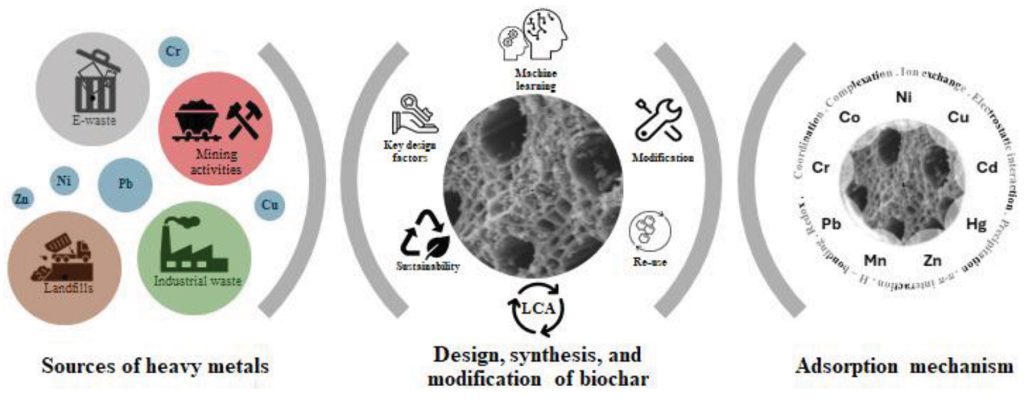
[Source: S. Chakma, M. Hasan, S. K. Rakshit, J. Kozinski, K. Kang, Can. J. Chem. Eng. 2026, 104, 1769.]
The next two articles are two open access articles from the ongoing Experimental Methods in Chemical Engineering Special Series: “Experimental methods in chemical engineering: Atomic absorption spectrometry—AAS” and “Experimental methods in chemical engineering: Electron probe micro-analysis—EPMA”. As the titles state, these articles explore the techniques of atomic absorption spectrometry and electron probe micro-analysis, specifically applications of and advances in these techniques as well as bibliometric analyses showing the fields in which these techniques are being used.
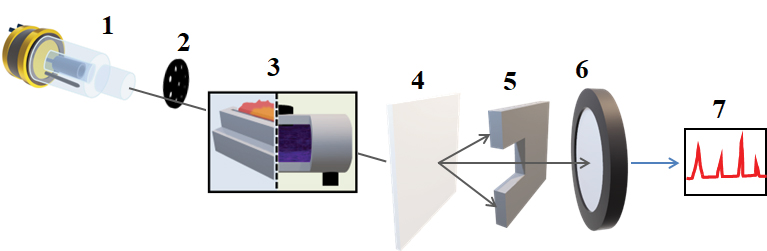
[Source: E. C. T. de A. Costa, J. de J. Santana, V. de O. Campos, F. F. Barbosa, G. S. Patience, Can. J. Chem. Eng. 2026, 104, 2206.]
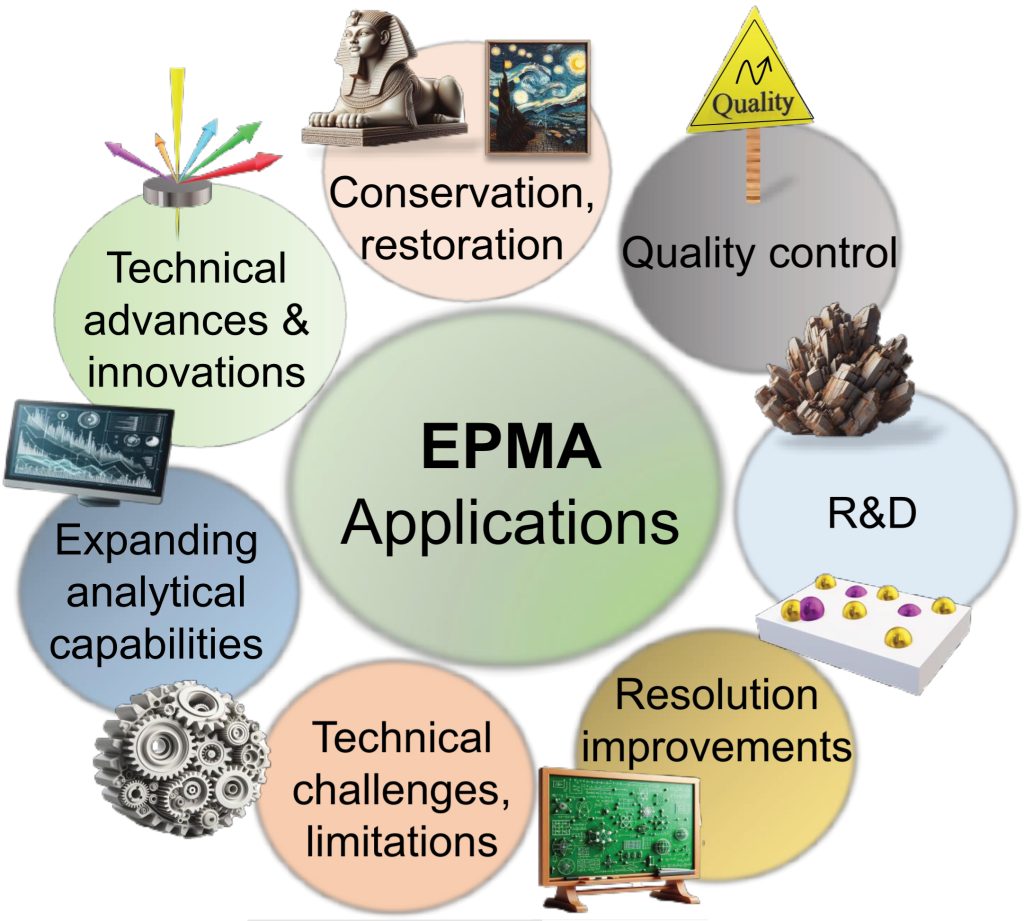
[Source: V. de Oliveira Campos, F. F. Barbosa, E. K. L. de Morais, D. M. A. Melo, J. de Jesus Santana, G. S. Patience, Can. J. Chem. Eng. 2025, 103, 3000.]
Next is another open access article titled “Fines deposition during hydrotreating: Effects of catalyst size and bed arrangement” from Simon Kwao, Sundaramurthy Vedachalam, Ajay K. Dalai, and John Adjaye: “Fines deposition presents a significant problem during the hydrotreating of bitumen-derived gas oils. The accumulation of fines leads to reactor clogging and consequently, pressure drop buildup. At critical levels, the hydrotreating reactor must be prematurely shutdown, resulting in substantial economic losses for refineries. Hence, research into finding measures to address fines deposition is crucial and of interest to stakeholders in the refining industry. This research explored the effects of catalyst size and bed arrangement on fines deposition, with the goal of identifying strategies to obtain longer hydrotreating run times.”
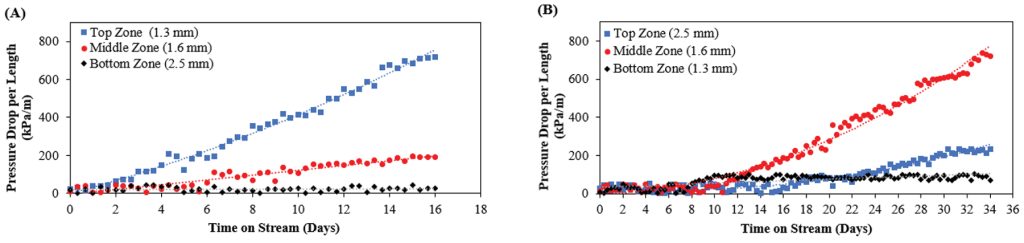
[Source: S. Kwao, S. Vedachalam, A. K. Dalai, J. Adjaye, Can. J. Chem. Eng. 2025, 103, 4390.]
Finally, this section of the virtual issue is concluded by an open access article titled “A catalytic sites contiguity study on atomically-dispersed ZnO-Cu/SiO2 catalysts to improve methanol formation from CO2 hydrogenation” from Jingye Chen, Mohsen Shakouri, Mehryana Alizadeh, Chi Cong Tran, Nan Zou, Serge Kaliaguine, Ying Zheng, and Hui Wang. This article is a special issue article from the Catalysis for Decarbonization Special Issue Section within the November 2025 issue. This article examines the “catalytic sites contiguity, for example, the surface orientation or arrangement of the CO2 and H2 activating sites and their capability to facilitate the interaction between the adsorbed species, and its effects on the catalytic performance of MeOH formation.” The results show that “the ALD ZnO-Cu/SiO2-C catalyst facilitated the MeOH space–time yield to 33.1 g/(kgcatal ∙ h) at 240°C, three times the yield of its Cu-only counterpart” and “the property–performance correlation indicated that two types of ZnO–Cu sites contiguity were responsible for MeOH and CO formation from CO2 hydrogenation with the ADZn2+–Cu+/Cu0 favouring more MeOH formation.”
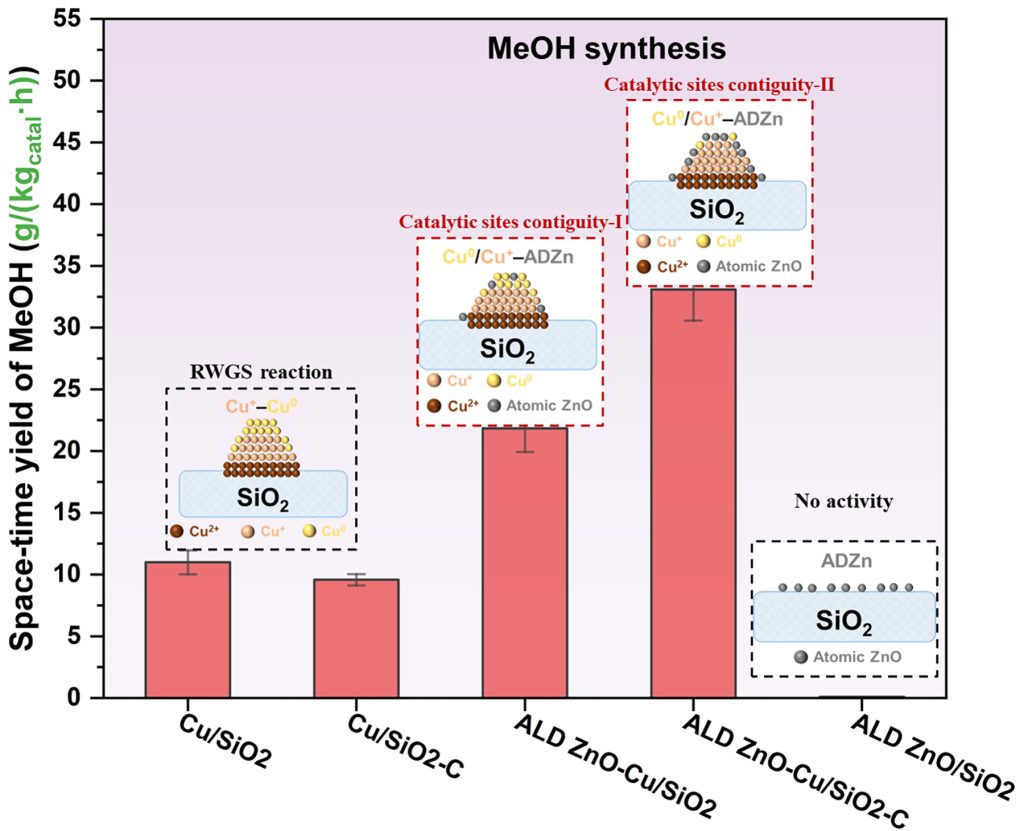
[Source: J. Chen, M. Shakouri, M. Alizadeh, C. C. Tran, N. Zou, S. Kaliaguine, Y. Zheng, H. Wang, Can. J. Chem. Eng. 2025, 103, 5218.]
One of the many benefits of publishing with CJCE is the availability of funding to authors for open access publication due to Wiley’s Transformational Agreements with funders and institutions across the globe. This includes institutions and consortia across North America. For information on open access funding by country, see Wiley’s Open Access Accounts by Country or Location page.