
 CJCE recently published its latest virtual issue: Amplifying Global Research. Within this virtual issue, you will find the 5 top-viewed articles published between 2025 and 2026 from each of the following continents: Africa, Asia, Europe, North America, and South America. Over the next several months, we will be highlighting the articles from each of these sections in a series of CIC News stories as a means of spotlighting the excellent research being conducted across the globe in chemical engineering.
This month, we will be highlighting the articles in this virtual issue with corresponding authors from institutions within Europe. As many of the co-authors of these articles are from various regions, countries, and continents, this reflects the truly international collaboration that is taking place in chemical engineering research.
The first article in this section is an open access article titled “Smiling warnings and silent complicity: An autoethnographic reflection on academic bullying and mobbing” from Daniele Marchisio: “Drawing on autoethnography, this article presents three anonymized vignettes from the field of chemical engineering to illustrate how identity-based coercion, institutional indifference, and enabling behaviours operate within academic culture. These narratives are situated within existing empirical literature, including large-scale survey data on abusive supervision in STEM disciplines. The analysis highlights the central role of power asymmetries, competitive pressures, organizational narcissism, and the normalization of excellence as mechanisms that render bullying morally ambiguous or institutionally invisible.”
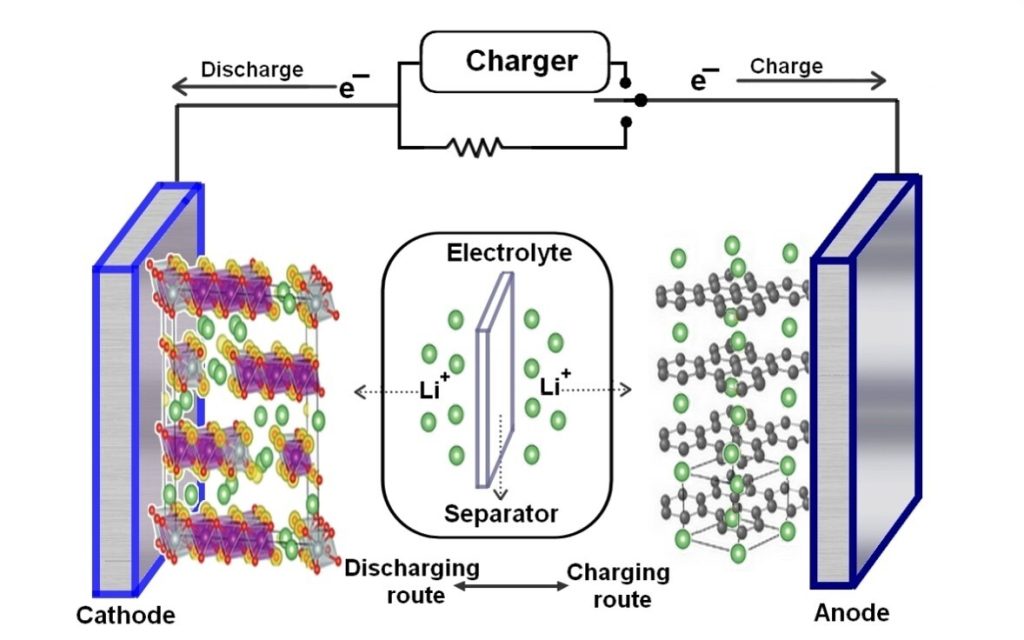
Next is a review article titled “A comprehensive review on the extraction and recovery of lithium from primary and secondary sources: Advances toward battery-grade materials” from Soner Top, Sait Kursunoglu, and Mahmut Altiner: “This review focuses on lithium recovery and purification strategies for battery-grade lithium carbonate (Li2CO3) and lithium hydroxide (LiOH), addressing both primary sources (brines and minerals) and secondary sources (waste materials). Industrially established processes, such as evaporation-based brine treatment and conventional metallurgical methods, are discussed alongside emerging techniques, including membrane separation, solvent extraction, and CO2-assisted precipitation.”
Source: S. Top, S. Kursunoglu, M. Altiner, Can. J. Chem. Eng. 2026, 104, 2573.
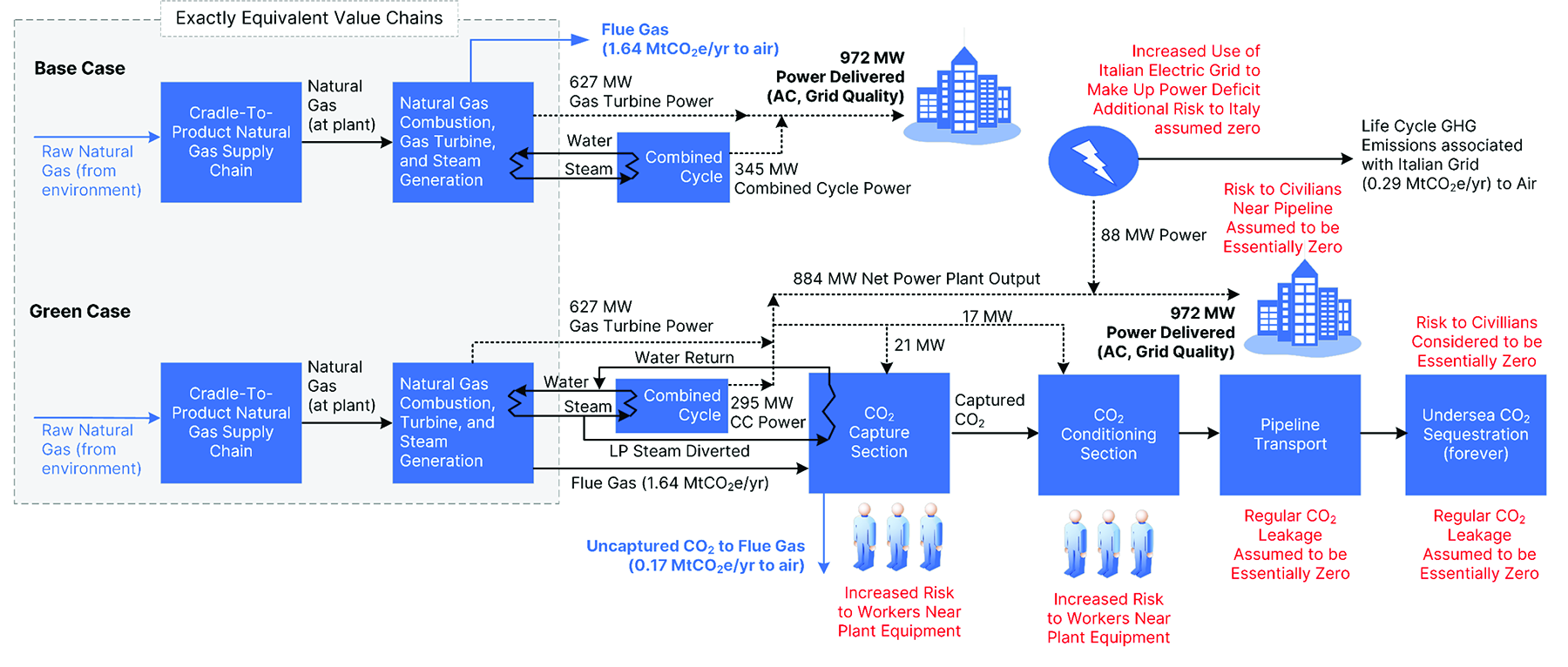
The third article in this section is another open access article titled “Weighing risks against GHG reduction benefits in emerging green technologies” by Federica Tamburini, Valerio Cozzani, Nicola Paltrinieri, and Thomas Alan Adams II: “Green technologies represent promising strategies for mitigating carbon emissions and combating global warming. However, their implementation in civil and industrial applications is not without risks, as intrinsic uncertainties and latent safety concerns can threaten their effective deployment. To quantitatively evaluate the trade-off between environmental benefits and safety issues, this work develops an innovative methodological approach. This approach aims to determine the risk–benefit profile of emerging green solutions through the definition and calculation of a new key performance indicator, the risk of CO2 avoided index (RCAI). By doing so, it provides a comprehensive understanding of the effectiveness of the green technology implementation and serves as a powerful tool for supporting stakeholder decision-making.”
Source: F. Tamburini, V. Cozzani, N. Paltrinieri, T. A. Adams II, Can. J. Chem. Eng. 2025, 103, 4661.
Next is an open access article titled “Experimental investigation of spreading dynamics of glycerol droplets on a heated surface” from Merve Durubal, Martijn Munck, Kay Buist, J. A. M. (Hans) Kuipers, and Maike Baltussen: “This paper presents an experimental study of the spreading dynamics of droplets of liquids with a temperature-dependent viscosity on a heated horizontal sapphire surface. This surface can be heated between 40 and 90°C and allows for usual observation from different directions. The used liquids are glycerol water solutions with a volume percentage of 80%, 85.2%, and 92.8% glycerol, which feature a large dependency of the viscosity on the temperature. Using high-speed imaging and infrared thermography, the shape of the droplet and the temperature of the droplet surface in contact with the surface are measured, respectively.”
Finally, this section of the virtual issue is concluded by an open access research article titled “Removal of benzotriazoles from domestic wastewater using Pleurotus ostreatus fungal pellets” by Evrydiki Markoulatou, Georgia Gatidou, Athanasios S. Stasinakis, and Michail S. Fountoulakis: “Benzotriazoles are a group of persistent and mobile substances commonly found in aquatic environments due to inefficient treatment in conventional sewage treatment plants. Hence, it is crucial to explore alternative technologies for their degradation to avoid their adverse effects on the environment and human health. The potential removal capability of four benzotriazoles and one benzothiazole (1H-benzotriazole, BTR; 4-methyl-1H-benzotriazole, 4TTR; 5-methyl-1H-benzotriazole, 5TTR; 5-chlorobenzotriazole, CBTR; xylytriazole, XTR; and 2-Hydroxybenzothiazole, OH-BTH) from domestic wastewater was investigated using the white-rot fungus Pleurotus ostreatus in pellet form.”
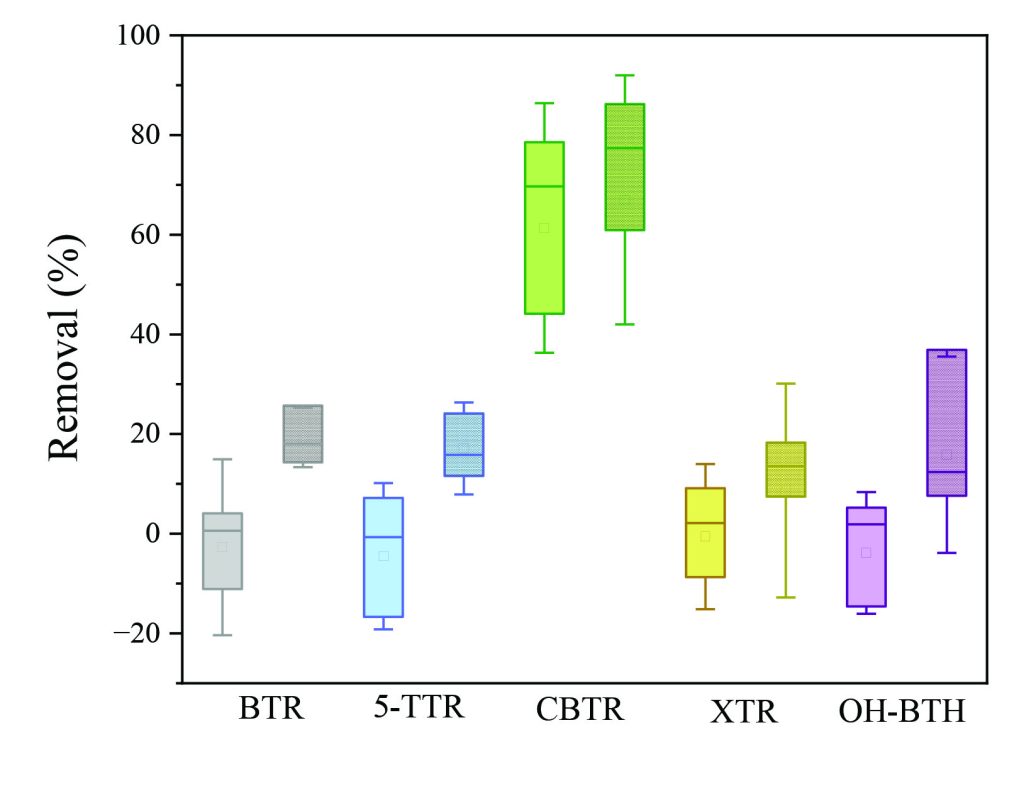
Source: E. Markoulatou, G. Gatidou, A. S. Stasinakis, M. S. Fountoulakis, Can. J. Chem. Eng. 2025, 103, 5812.
One of the many benefits of publishing with CJCE is the availability of funding to authors for open access publication due to Wiley’s Transformational Agreements with funders and institutions across the globe. This includes institutions and consortia across Europe. For information on open access funding by country, see Wiley’s Open Access Accounts by Country or Location page.