
João B. P. Soares
Department of Chemical and Materials Engineering
University of Alberta
Edmonton, Alberta, Canada
Thomas A. Adams II
Department of Energy and Process Engineering
Norwegian University of Science and Technology
Trondheim, Norway
Peer review is one of the foundations of scientific publishing. It helps validate results, identify errors, improve manuscripts, and maintain trust in the scientific record.
Unfortunately, there is a growing fear that this time-tested method of assuring the quality of scientific publications is undergoing a crisis. However, the many frustrations commonly attributed to peer review are not caused by the process itself, but by the way it is sometimes practiced: reviewers that are too demanding, too superficial, or demand changes in scope; authors that treat every criticism as hostile or are too accommodating to unreasonable reviewing demands; editors that count recommendations rather than evaluate their quality. Increasingly, concerns are also being raised about citation manipulation and the inappropriate use of artificial intelligence in manuscript preparation and assessment.
Restoring the quality of peer review requires a shared understanding of the responsibilities of reviewers, authors, and editors alike. Our recent article (J.B.P. Soares, T.A. Adams II, On the defence of responsible human judgment in peer review, Canadian Journal of Chemical Engineering, 2026, DOI:10.1002/cjce.70497) discusses the mandates of reviewers, authors, and editors in details. To accompany that article, we developed the following three practical decision guides discussed in this CIC News communication: a Reviewer Decision Guide, an Author Response Guide, and an Editorial Judgment Guide.
Although each flowchart addresses a different participant in the peer-review process, they are interconnected. The reviewer guide promotes fair and constructive evaluations. The author guide promotes evidence-based responses. The editor guide ensures that both reviews and rebuttals are judged critically and fairly. Together, these three tools form a practical integrated approach for responsible peer review and reinforce the principle that scientific publishing works best when reviewers, authors, and editors uphold high standards of professionalism, fairness, and intellectual integrity.
The Reviewer’s Responsibility
The primary duty of a reviewer is to evaluate the manuscript that was submitted, not the manuscript they would have preferred to receive. This should be an obvious distinction, yet many reviewers fail to understand that their responsibility is to evaluate the quality the work done by the authors, not to request scope extensions.
A good review begins by understanding the authors’ objectives and assessing whether the work is scientifically sound, clearly presented, sufficiently novel, and significant within its intended scope. Reviewers should distinguish major concerns from minor ones, provide specific and actionable comments, and ensure that their recommendations are proportional to the seriousness of the identified shortcomings.
Several common problems arise when these principles are ignored. Reviewers may request extensive additional experiments that are not necessary to support the conclusions of the submitted work. Minor deficiencies may accumulate into recommendations for rejection even when the underlying science is fundamentally sound. Citation requests may sometimes reflect personal preference or self-interest rather than genuine relevance.
Professionalism also matters. Reviews should critique the work, not the authors. Confidentiality must be respected, and reviewers should never outsource their scientific judgment to artificial intelligence tools or other third parties.
A final question for reviewers: Would I consider this review fair if I received it myself?
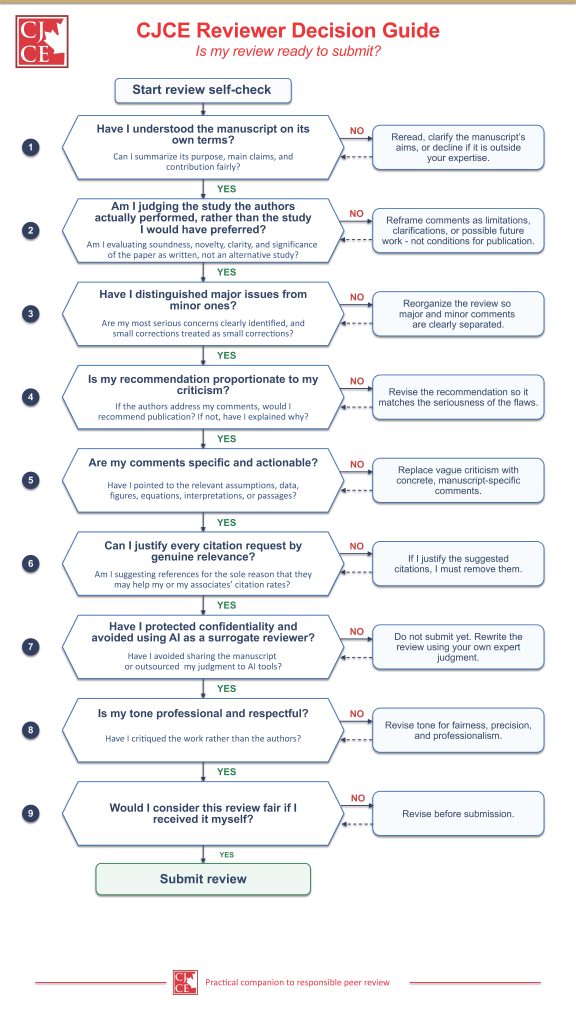
The CJCE Reviewer Decision Guide encourages reviewers to evaluate manuscripts on their own terms. Reviewers should understand the purpose and contribution of the submitted work, distinguish major from minor concerns, ensure that recommendations are proportional to criticisms, and provide specific, actionable comments. The guide also highlights ethical concerns such as inappropriate citation requests, breaches of confidentiality, and the misuse of artificial intelligence as a surrogate reviewer.
The Author’s Responsibility
Receiving criticism is rarely pleasant. Nevertheless, authors should remember that the purpose of peer review is to improve the scientific record, not to validate personal effort.
The most effective rebuttals distinguish between comments that genuinely improve the manuscript and comments that do not. Legitimate criticisms should be addressed carefully and transparently. When authors disagree with reviewers, they should explain their reasoning clearly and support their position with evidence from the manuscript, the literature, or established scientific principles.
Not every reviewer request must be accepted. Some requests may exceed the intended scope of the study, require disproportionate effort relative to the issue being raised, or reflect misunderstandings of the work. In such cases, authors should respond respectfully and explain why they have chosen not to implement the suggested change.
Strong rebuttals are neither defensive nor confrontational. Their purpose is to help editors understand what changes were made, why they were made, and why certain requests may have been declined. The goal is not to win an argument. The goal is to help the editor reach the most scientifically justified decision.
A final question for authors: Is my response firm, fair, and evidence-based?
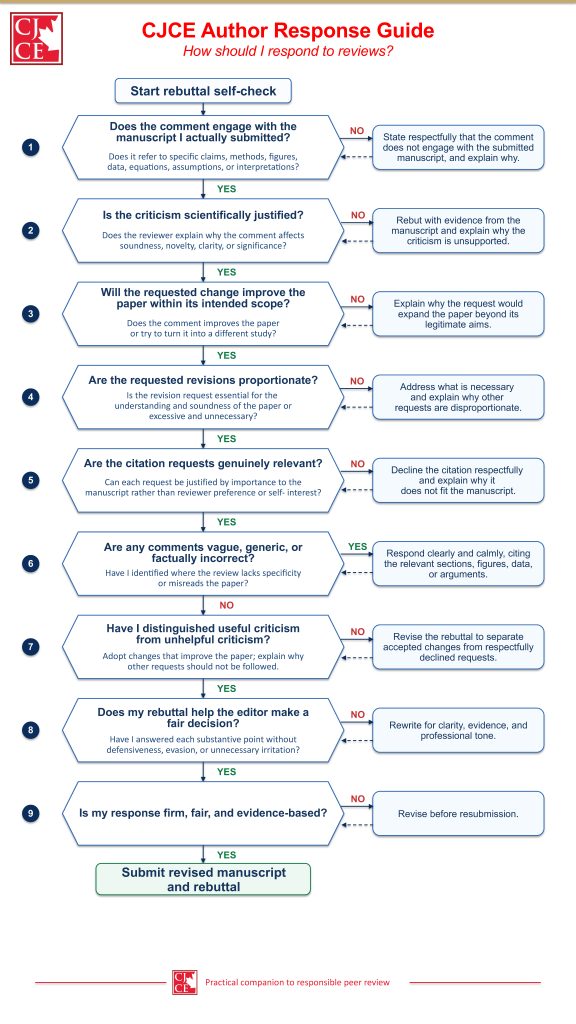
The CJCE Author Response Guide reminds authors that not every reviewer comment must be accepted, but every substantive comment deserves a thoughtful response. Authors should address legitimate criticisms, distinguish useful suggestions from scope-expanding requests, and provide evidence-based explanations when they disagree with reviewers.
The Editor’s Responsibility
Editors occupy a unique position within the peer-review process. They must evaluate not only manuscripts but also the quality of the reviews themselves.
A common misconception is that editorial decisions should simply follow reviewer recommendations. In reality, recommendations are only one component of a review. What matters most is whether the criticisms are specific, evidence-based, and proportionate.
Editors should ask whether reviewers have identified substantive scientific flaws or merely accumulated numerous minor objections. They should distinguish between criticisms that affect the validity of a study and requests that would simply expand its scope. Generic comments, unsupported assertions, and questionable citation requests deserve little weight regardless of the recommendation attached to them.
Editors must also evaluate authors’ responses fairly. A manuscript should not be penalized merely because authors disagree with reviewers. What matters is whether those disagreements are supported by clear scientific reasoning.
Ultimately, editorial responsibility cannot be delegated to reviewers. Reviews inform decisions; they do not make decisions. The final judgment belongs to the editor.
A final question for editors: Is my final decision truly mine, based on the quality of the reviews and responses?
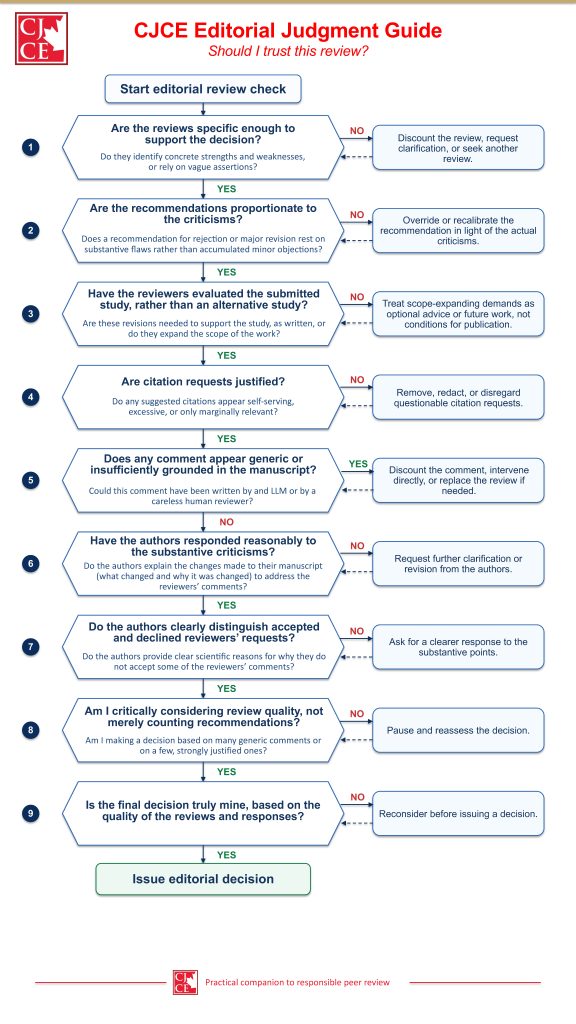
The CJCE Editorial Judgment Guide emphasizes that editors must evaluate the quality of reviews rather than simply count recommendations. Editors should assess whether criticisms are specific, proportionate, and genuinely relevant to the validity of the study. Generic reviews, unsupported assertions, and questionable citation requests should be given little weight.
Toward a Healthier Peer-Review Culture
Peer review functions best when all participants understand both their rights and their responsibilities. Peer review is often discussed as a mechanism for quality control, but it is also a culture. Healthy peer-review cultures are built on accountability, proportionality, transparency, and mutual respect. Improving peer review requires participation from everyone involved in the publication process.
Reviewers should provide fair, specific, and proportionate evaluations. Authors should respond with evidence and professionalism. Editors should exercise independent judgment rather than relying on a simple tally of reviewer recommendations.
When these responsibilities are fulfilled, peer review becomes a collaborative process that strengthens manuscripts, improves scientific communication, and reinforces trust in the research enterprise.